Uninhabitable Acts

We keep comparing humans to systems on the wrong axis.
The debate usually defaults to raw intelligence or processing efficiency. Systems optimize better. They scale endlessly. On those terms, humans have already lost.
The actual divergence happens elsewhere.
Systems can act without having to live inside what their actions mean. Humans cannot.
A system executes a command or processes an outcome. It never has to ask: What does this make me? For a human, that constraint dictates everything. We do not evaluate action by outcome alone; we evaluate it by what it turns us into. A choice can be correct, even rewarded, and still feel impossible because performing it requires becoming someone we cannot bear being.
The true barrier to action is rarely Can I? It is more often What would it make me if I did this?
Speak up, and become disloyal.
Leave, and become unreliable.
The action exists, but the required identity is unlivable. Uninhabitable.
A computer, machine, system, or even an institution does not face this problem. It does not inhabit its actions. It can reverse itself overnight or optimize metrics that quietly degrade the people inside it, and nothing fractures internally.
If you assume humans are mere outcome-optimizers, control looks like a practice of restricting options. If humans are meaning-bound, control operates entirely differently. The most efficient way to govern behavior is not prohibition. It is making the protective act feel like selfishness, or the truthful act feel like disloyalty.
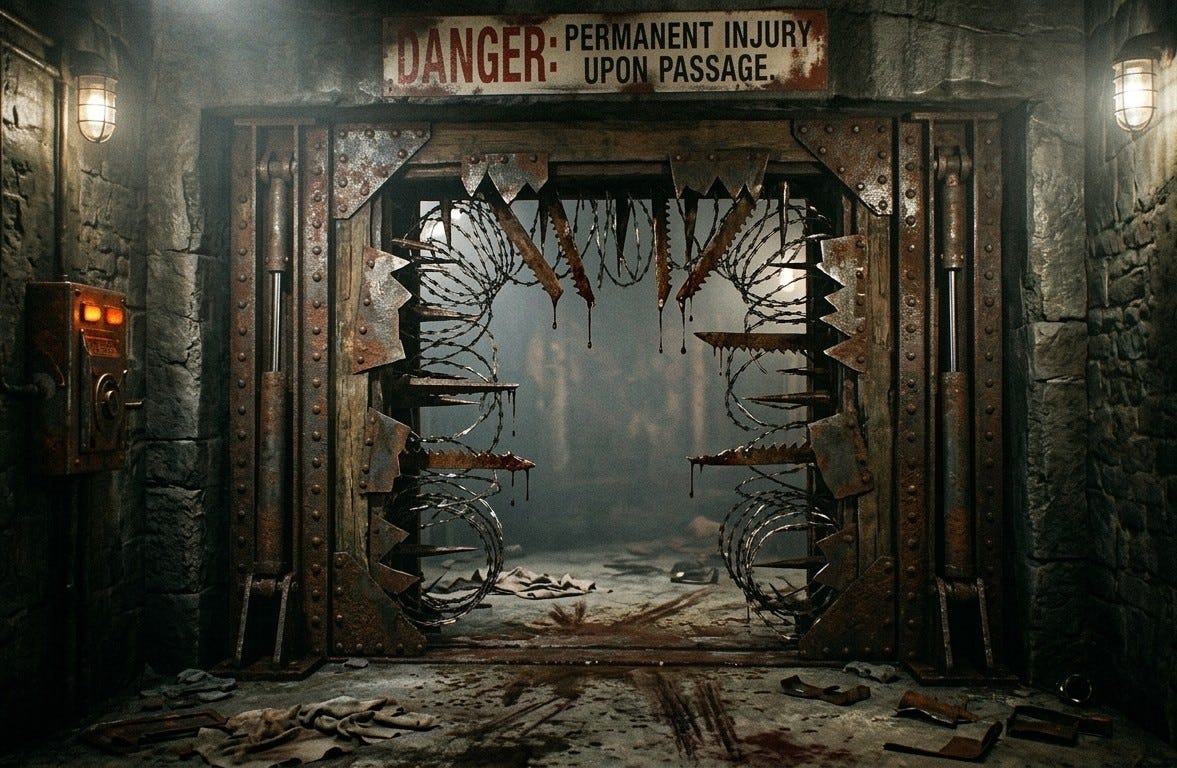
You do not need to close the door if you can make walking through it unlivable.
This explains the gridlock of modern institutions. We are told that once people are given rights and incentives, movement will follow. When it does not, the individual absorbs the blame. We call them fearful, passive, or lazy.
That diagnosis mistakes available action for inhabitable action.
An action is not functionally real just because it exists on paper. It is only real if a person can survive being the one who takes it. If using a right makes you unsafe or morally compromised, the option sits unused. That non-use is then cited as evidence that the right was not needed. The architecture disappears behind the appearance of choice.
Failing to recognize this means continually misreading structural failure as personal weakness.
It also leaves us blind to the demands of our own built environments. As social life routes itself through automated, legibility-hungry infrastructures, the pressure grows for humans to become frictionless too: faster, clearer, more compliant.
But a human being is not simply a slower system.
A system proceeds as long as the action works. A person stops when the action becomes unlivable, even if it works perfectly. We usually call that stopping point conscience.
Conscience is not an error in the human design. It is one of the last protections against a world organized entirely around execution.
The same feature that makes us capable of refusal makes us uniquely vulnerable. We remain in bad situations because leaving would collapse our sense of self. We fail to act not because the path is hidden, but because the self required to walk it has been made impossible.
Systems do not suffer this way. They do not break under meaning.
We do.
The defining boundary between a human and the systems that surround them is not optimization. It is that we are meaning-bound. We do not just act. We have to be able to live with the kind of actor an action makes us.
Systems [must] execute.
Human beings [must] inhabit.
And if we fail to defend that distinction, we will keep building systems that treat conscience as inefficiency, paralysis as preference, and domination as a problem of bad choice architecture.